Friday, November 11, 2011
fashion STATEMENT: Native Artists Against Pebble Mine
fashion STATEMENT: Native Artists Against Pebble Mine is a traveling exhibit of wearable art that highlights a rural Alaskan community's opposition to foreign mining investors attempting to build North America's largest open pit mine at the headwaters of their fragile salmon spawning grounds.
Native Alaskan fisherwoman and artist Anna Hoover curated the exhibit as her Master's Degree project for the University of Washington.
The show, comprised of artwork created by internationally celebrated Native artists reproduced on t-shirts and limited edition prints, will be exhibited and made available online for purchase to raise awareness for this movement.
In August the exhibit premiered at the International Gallery in Anchorage, and on November 3rd, it opened at the Burke Museum in Seattle. It will continue to travel to a series of venues around the US, Canada and New Zealand.
The Natural Resources Defense Council has stated, “If the Pebble Mine is allowed to go forward, it will inflict irreversible damage on Bristol Bay -- including the permanent destruction of sixty miles of salmon habitat.”
The show features designs by esteemed Native artists such as Joe David, James Luna and Larry McNeil, all of whom have asserted the centuries long relationships that Native peoples have created with their environments, through Native art activism.
To view and purchase the T-shirts designed by the artists in the show, visit: www.nativeartistsagainstpebblemine.com
Click here to listen to an interview with Anna Hoover.
Monday, October 17, 2011
Dressed Just Right Exhibition
Her red dress, pictured on the left, was on display at the "contemporary platform" - representing some of the best current western fashion today. It's really cool to see a Native-inspired dress, made by a Native person, exhibited in the 'contemporary' section - because most of the time our awesome gear is relegated to the sections devoted to 'the past.'
Carpenter was also recently awarded the Best Fashion Collection at the Annual Cody High Style Fashion Show held every fall in Wyoming. Here's a few pics from her collection:
Read more about Carpenter by clicking here or here.
Friday, August 12, 2011
Virgil Ortiz's Vertigo
Virgil Ortiz's latest exhibit, Vertigo, opened last week at the Museum of Indian Arts and Culture in Santa Fe (just fyi, I'm no longer living in Santa Fe, and I'm crushed that I can't attend every opening! Sadtimes. BUT, since I will be in Santa Fe for their annual Indian Market, I will still get to check out the show. Awesome.).
About Vertigo (Ortiz always has the best one-word show names, I swear), the Museum press release explained,
The past receives a current voice with the newest figurative work of Virgil Ortiz. With pieces whose scale and style are both unprecedented, the Vertigo series infuses cultural understanding and historic research. Just as his ancestors used clay to comment on their lives and experiences; Ortiz does the same and adds a fresh element and spin by enlisting family members to contribute their respective works in this spectacular series.
Inspired by Ben Wittick’s famous photograph, circa 1880, Ortiz recreates the scene using a photograph of the Charles Bridge he took during a visit to Prague, Czech Republic in 1999.
“When I walked up to the Charles Bridge, it reminded me of that photo from the Clay People book and I knew someday I would recreate it.” – Virgil Ortiz
So if you plan on checking it out, here's the dish:
WHAT: “Vertigo: A Spin on Tradition ~ Reviving the Past” with Virgil Ortiz and family members
WHEN: Monday August 1st through September 5th, 2011
WHERE: Museum of Indian Arts & Culture | 710 Camino Lejo, Museum Hill off Old Santa Fe Trail, Santa Fe New Mexico. Phone: 505.476.1250
“There is no better illustration from an artist who constantly challenges his abilities to mold clay into forms never imagined. The Vertigo series comes full circle and ends with the traditional “Mono” at this point in time.” – Robert Gallegos, Art Dealer - Historian
ALSO: Keep your eyes open for Ortiz's collaboration with Aqua Hospitality Carpets.
Saturday, August 28, 2010
Ralph Lauren Vintage Native American exhibition

If you happen to find yourself in Tokyo, jont on over to the Monaco Grand Gallery to view the Ralph Lauren Vintage Native American exhibition. The exhibition features Ralph Lauren's collections inspired by American Indian motifs and designs. I'm not aware of any other exhibit to look at his Native collections - so it should be interesting to see all of these examples in one setting. Lauren is well-known for his 'Americana' gear, and his Polo products embraced an idealized aspect of the American cultural experience.
His Santa-Fe collection was added to the brand in 1981, providing Navajo-inspired designs that were a global success, and he has probably done more than any other designer to romanticize the Southwest.
The exhibition will take place at the Monaco Grand Gallery and opened on August 27th, 2010.
Monaco Grand Gallery
36-4 Toyodabiru udagawachou
Shibuya-ku, Tokyo
Japan
Thursday, June 24, 2010
Exhibit | A Song for the Horse Nation

(Glass horse mask, 2008, by Marcus Amerman (Choctaw, b. 1959), New Mexico. Multicolored glass. Photograph by Ernest Amoroso, NMAI)
A Song for the Horse Nation Introduction:
The story of the relationship of Native peoples and horses is one of the great sagas of human contact with the animal world. Native peoples have traditionally regarded the animals in our lives as fellow creatures with which a common destiny is shared. When American Indians encountered horses—which some tribes call the Horse Nation—they found an ally, inspiring and useful in times of peace, and intrepid in times of war. Horses transformed Native life and became a central part of many tribal cultures.
By the 1800s, American Indian horsemanship was legendary, and the survival of many Native peoples, especially on the Great Plains, depended on horses. Native peoples paid homage to horses by incorporating them into their cultural and spiritual lives, and by creating art that honored the bravery and grace of the horse.
The glory days of the horse culture were brilliant but brief, lasting just over a century. The bond between American Indians and the Horse Nation, however, has remained strong through the generations.

(Spanish expedition pictograph. Nancy Nehring. Canyon de Chelly National Monument, Arizona. Courtesy of Getty Images)
Return of the Horse Nation:
The horse originated in the Americas more than 40 million years ago. After spreading to Asia and Europe, it became extinct in its homeland. In 1493, the horse returned to the Western Hemisphere when Columbus brought a herd of 25 on his second voyage. Back in the Americas, its native environment, the horse flourished.
The Spanish used the horse as an instrument of warfare and control. But as soon as horses came into Indian hands, Native peoples began to weave a close relationship with the Horse Nation. By the late 1700s, virtually every tribe in the West was mounted. Horses strengthened Native communities and helped in the fight for Indian lands.

(Central Plains (possibly Oto or Kaw) beaded leggings, ca. 1900. Oklahoma. Seed beads, metal spots, pigment, hide, and cotton thread)
Clothing and Personal Items:
As European and Native cultures met, new styles developed. Western-style clothing and new trade materials, such as glass beads, wool, and cloth, would influence Plains culture. Beaded horse designs would now be depicted on Western-style clothing and other personal items.

(Lakota beaded hide coat, ca. 1890. Cut beads, metal buttons, cotton cloth, hide, and sinew)
This Western-cut hide jacket is beaded with figures on horseback. But instead of illustrating an individual’s exploits, these are simply decoration. The horses’ tails are doubled and tied in preparation for battle.

(Walla Walla beaded bag, ca. 1915. Washington. Seed beads, wool cloth, canvas, hide, and cotton thread. Photograph by Katherine Fogden, NMAI)
The Native peoples of the Plateau region (covering modern-day Idaho, Oregon, and Washington State) have a long artistic history of weaving cornhusk bags. After trade goods became widely available, they made cloth bags decorated with glass beads. This one features a man astride a prancing horse, wearing what appears to be the Army uniform of a corporal.

(Tsitsistas/So'taeo'o (Cheyenne) beaded tipi bag, ca. 1880. Montana. Seed beads, horsehair, tin cones, feathers, porcupine quills, pigment, hide, and sinew)

(Chaticksi (Pawnee) coat belonging to Lone Wolf, ca. 1910. Oklahoma. Hair locks, sweetgrass, seed beads, feathers, horn, porcupine quills, pigment, wool cloth, cotton cloth, hide, and sinew. Photograph by Katherine Fogden, NMAI)
This Western-style tailored coat reflects the influence of the white world on Plains culture in its straight body, even hem, and collar, as well as in its decorative use of five-pointed stars and crosses. The two-toned speckled horse with the horn on its forehead could represent a pinto or a spirit horse.

(Spokane woman on horseback with infant in baby carrier, 1900. Colville Reservation, Washington. National Museum of the American Indian)
When a tribe acquired horses, the status of women improved. Horses helped lighten the work load, and women gained more time for creating art and social involvement. Women’s arts, such as beadwork and ornamenting hides with porcupine quills, flourished.
(To learn more about this exhibit, visit the website at A Song for the Horse Nation)
Thursday, March 25, 2010
Exhibit | POP! Popular Culture in American Indian Art

The Heard Museum in Phoenix Arizona will be opening a new exhibit on April 16, 2010. The exhibit, POP! POPULAR CULTURE IN AMERICAN INDIAN ART, runs through April 2011.
The exhibit displays how pop culture and innovation collide with traditional art forms and cultures in artwork that reflects contemporary issues and imagery in an often comedic, tongue-in-cheek way. Fashion, graffiti art, comics, pottery and beadwork are formats for contemporary American Indian artists who incorporate imagery from popular culture into their work.
Beadworker and fashion designer Marcus Amerman will be one of the artists featured in the exhibit.
And peep these shoes by Paula Rasmus-Dede (Aleut, b. 1946): "Clearly Red Hot Mama," 2010
Friday, March 12, 2010
Article | Clothes, Culture and Identity

Check out this review of the fashion and clothing-based exhibition Native/American Apparel for the Costume Museum of Canada:
Clothes, Culture and Identity: Native/American Apparel asks harder questions than "does this make my butt look fat?"
by Sandee Moore
"The clothes make the man," the saying goes; dress provides important cultural clues about the wearer's status. For example, the length of the apron on an amauti (Inuit parka) indicates fecundity. In her exhibition Native/American Apparel for the Costume Museum of Canada, curator Jenny Western has brought together a motley bunch of objects from the museum's collection with fashion-based work by two contemporary Aboriginal artists. Boundaries between European and Indigenous, traditional and modern, and fashion and art are traversed, creating a multi-faceted view of Aboriginal identity as expressed in clothing.
Sewing has been a form of self-expression for artist Lita Fontaine since her teens, when she made much of her clothing herself. Eventually she turned her needle skills into an investigation of her traditional culture. A jingle dress, a fairly modest garment with a long skirt adorned with clattering shells and appliquéd ribbon, is juxtaposed against four merry widow corsets that Fontaine has dyed, beaded and otherwise adorned. The corsets - red, yellow, black and white - are arrayed around a drum, also handmade by Fontaine. By marking the sacred four directions with seductive lingerie, the artist questions sexism in modern-day ceremonial practices. In the past, the artist had been informed that women were unwelcome in the drum circle and they most certainly did not make drums.
That said, I get the impression that this drum has been beaten plenty already.
Fontaine's other works in Native/American Apparel are wooden cut-outs of dresses painted with floral motifs. It's exciting to see a painter get away from the rectangular canvas; here, the paintings can be read both as dresses and as landscapes.
A display featuring a white-clad snowboarder is the work of KC Adams, who has been creating all-white worlds as a way of discussing issues of Aboriginal identity for several years now.
Close by are several photos from Adam's Cyborg Hybrid series. These works really shine, not just because of the bling-y wardrobes of her subjects. Adams has taken portraits of various people of mixed (hybrid) Aboriginal heritage wearing a white T-shirt customized by the artist with opalescent beads that spell out a racist or stereotypical statement about Aboriginal people. The phrases range from the inflammatory to the perverse and obscure - "How do you like my sweet grass?" Using digital techniques, Adams has enhanced each subject; the result is plastic, android-like perfection.
Adam's Cyborg Accessories, which combine ultra-modern functions with beadwork, fur and other materials traditionally associated with First Nations handicrafts, are displayed in a nearby case. Her beaded USB bracelet and rhinestone-encrusted hide iPod holder echo a grouping of kitsch objects, including a buckskin card holder branded with the iconic profile of an Indian chief and a small beaded wallet from the museum's collection.
Naïve cultural appropriation, such as high-heeled moccasins, may be something we can look upon with smug superiority now, but Native/American Apparel also shows that fusion may produce incisive political statements or astounding objects that transcend cultural categories.
[original article can be found at Uptown Magazine]
NATIVE/AMERICAN APPAREL
Until April 4, Costume Museum of Canada
Native/American Apparel looks at the relationship of fashion, clothing, and textile to the representation of Indigenous identities. By juxtaposing historical artifacts with current artworks, the exhibition encourages viewers to consider the role of the collection and exhibition of objects made by First Nations and Métis people in museums, particularly those objects made by women.
Thursday, March 4, 2010
Exhibit | HIDE: Skin as Material and Metaphor
HIDE: Skin as Material and Metaphor is a two-part exhibition at The National Museum of the American Indian, George Gustav Heye Center in New York, NY. Part I will be open to the public March 6, 2010 until August 1, 2010. Part II will be open to the public September 4, 2010 until January 16, 2011.
• SONYA KELLIHER-COMBS: MARCH 6–AUGUST 1, 2010
• NADIA MYRE: MARCH 6–AUGUST 1, 2010
• MICHAEL BELMORE: SEPTEMBER 4, 2010–JANUARY 16, 2011
• PHOTOGRAPHY/SHOWING SKIN: SEPTEMBER 4, 2010–JANUARY 16, 2011
For Native people, skin encompasses an entire universe of meaning. Our own skin functions as a canvas that we can inscribe with messages about our identity or use as a shield to protect and hide our secrets. As a material, animal skin or hide has had a long history within Native culture. It is a symbolic reminder of historical misrepresentation, exploitation, and racial politics. The artists selected for HIDE draw upon this subject in multi-faceted ways, using both the material and concept of skin as a metaphor for widespread issues surrounding identity and personal, historical, and environmental trauma and perseverance. In their work, they interrupt our understanding of race, distort our perception of “skin,” and breach the artificial boundaries created by this potent subject matter. Rather than hiding difficult issues, they expose what is beneath the surface.
Sonya Kelliher-Combs, Nadia Myre, and Michael Belmore each present bodies of sculptural and mixed-media work that explore skin as a surface—revealing, concealing, and defining. The work of these artists awakens the senses, drawing the audience into a tactile experience of the materiality of their work as well as making them think about the complex ideas that emerge from this compelling art. The photographers invited to participate in the exhibition—Arthur Renwick, KC Adams, Terrance Houle, Rosalie Favell, and Sarah Sense—have created a diverse collection of portraits that play with and challenge our notions about the representation of Native people.
Kathleen Ash-Milby, Curator
For more information go to: http://www.nmai.si.edu/exhibitions/hide/
Tuesday, March 2, 2010
Exhibit | Native / American Apparel
A new exhibit at the Costume Museum of Canada, in partnership with Urban Shaman: Contemporary Aboriginal Art
Featuring artwork by KC Adams and Lita Fontaine
Curated by Jenny Western, Urban Shaman Curator-in-Residence
About Native/American Apparel:
Bringing together artwork by contemporary Aboriginal artists, Lita Fontaine and KC Adams, alongside pieces from the Costume Museum of Canada’s permanent collection, Native/American Apparel looks at the relationship of fashion, clothing, and textiles to the representation of Indigenous identities. By juxtaposing historical artifacts with current artworks, this show encourages viewers to consider the role of the collection and exhibition of objects made by and about First Nations, Inuit, and Métis people in galleries and museums - particularly those objects made by women.
About KC Adams:
Since graduating from Concordia University with a BFA, Winnipeg-based artist KC Adams has taken as her focus the investigation of the relationship between nature (the living) and technology (progress). She works in a variety of media, including sculpture, installation, drawing, painting, photography, ceramics, printmaking and kinetic art. She maintains her own website at http://www.kcadams.net showcasing her work and flash art projects. Adams has had several solo exhibitions, most recently Cyborg Hybrids at the Odd Gallery in Dawson City, YK and Modern Fuel in Kingston, ON. She has also been featured in numerous group exhibitions, Cyborg Living Space II, The Language of Intercession at the OBORO Gallery in Montreal, Cyborg Hybrids at the PHOTOQUAI: Biennale des images du monde in Paris, France. She has participated in residencies at the Banff Centre, the Confederation Art Centre in Charlottetown and the Annex Gallery in Winnipeg. Adams has received several grants and awards from Winnipeg Arts Council, Manitoba Arts Council and Canada Council for the Arts. Twenty pieces from the Cyborg Hybrid series is in the permanent collection of the National Art Gallery in Ottawa.
About Lita Fontaine:
Lita Fontaine (Dakota/ Anishinaabe /French) holds a Master of Fine Arts Degree (Intermedia) from the University of Regina (2001) and a Diploma in Fine Arts from the School of Art, University of Manitoba (1997). Fontaine’s mediums include photo-base art, photography, mixed media and installation. She is an Arts Educator and is currently employed as the Artist in Residence with the Seven Oaks School Division in Winnipeg, Manitoba. Fontaine has participated in solo and group exhibitions. Her most recent exhibition: The Sacred Feminine was held at the Urban Shaman Gallery, March 2006. One of Fontaine’s major exhibitions titled: Lita Fontaine: Without Reservation opened at the Winnipeg Art Gallery in January 2002. A publication of this exhibition was cataloged, curatorial essay written by Catherine Mattes. Lita Fontaine collected works can be seen within the Winnipeg Art Gallery, Manitoba Legislature and several private collections. She has received several awards from the Manitoba Arts Council; The Canada Council for the Arts and the National Aboriginal Achievement Foundation.
January 19 – April 4, 2010
At the Costume Museum of Canada
109 Pacific Ave.
Winnipeg, MB R3B 0M1
204 989 0072
info@costumemuseum.com
http://www.costumemuseum.com
Monday, January 11, 2010
Group | UNRESERVED Alliance
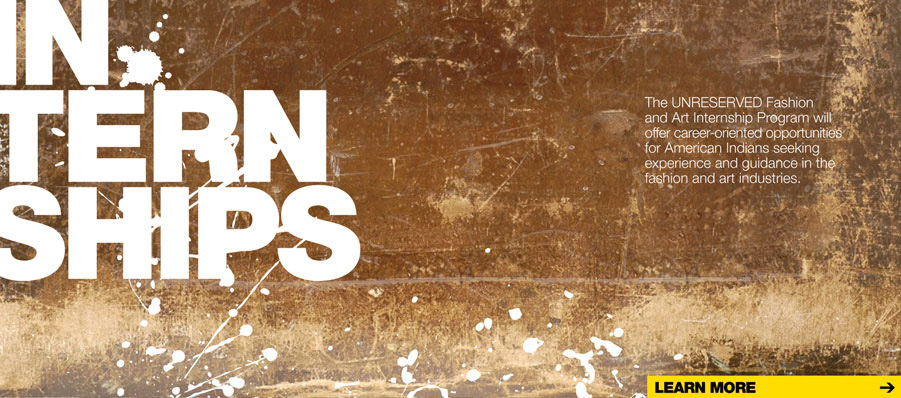
UNRESERVED is a new collective based out of New York and formed by a team of American Indian entrepreneurs and leaders from the international worlds of fashion and art.
Dedicated to empowerment, education and sustainability, their goal is to help American Indian designers and artists find careers in the art and fashion industries, allowing them to incorporate their skill sets and traditional heritage while establishing financial independence and encouraging cultural renewal within American Indian communities.
The mission of UNRESERVED is to encourage American Indians interested in exploring and pursuing careers in the worlds of fashion and art through internships. UNRESERVED seeks to create awareness and bridge American Indian communities with established companies and organizations, renewing the relevance and power of American Indian cultures, ensuring self-sufficiency and economic development.
They launched last summer with a $400,000 WK Kellogg Foundation grant, and held their first public reception at the Santa Fe Indian Market last August. Their first art exhibit will be IN/SIGHT, which will be on view at the
Fashion and art go hand-in-hand with American Indian culture, and UNRESERVED seeks to prep the runway and open gallery doors for undiscovered American Indian talent. Their annual calendar includes fashion shows, art exhibitions and events as well as internship programs. Check out their website for more information, and information on opportunities.
Friday, December 11, 2009
Event | Footwork: Art and the Shoe
(by Crystal Worl)In October I traveled to Oklahoma to participate in the 16th Biennial Native American Art Studies Association Conference, and met two students from the Institute of American Indian Arts (IAIA) who were planning to curate a show at IAIA's Primitive Edge Gallery in December and January. Their idea was to have an event focused on shoes, and the exhibit recently opened in Santa Fe:
Footwork: Art and the Shoe Primitive Edge Gallery
IAIA Campus in Santa Fe, New Mexico
Dec 10, 2009 through Jan 24, 2010
Indigenous people have always made a concentrated effort to adorn themselves in a beautiful way. Footwork is a showcase of footwear and art, and how the two have forever been a part of the Native way of life--the paths we walk and the steps we take into the future.
Now that I'm in Santa Fe, I plan to check out the show before it shuts down!
Monday, October 19, 2009
Exhibit | Native Couture II: Innovation and Style
Check out this revolutionary exhibit that I co-curated in Santa Fe:
Native Couture II: Innovation and Style
Museum of Indian Arts and Culture
Santa Fe, NM
August 30, 2009 through February 10, 2010
This exhibition explores the history of Native fashion from hand-made clothing and accessories of the 1880s that influenced the development of a Santa Fe Style, to today’s contemporary Native couturiers. At its root, Indian art is the quintessential original American art. This centuries-long influence of Native American art requires the buyer, or wearer, and the American public in general to ponder the origins of a truly unique American style.


(KC Adams - Cyborg Hybrid Donna, 2009)